What Are These Crawlers and Why Are They on My Site?
When you open your access logs or analytics, you’ll see a surprising number of “bots” hitting your pages. These visitors are not humans but web crawlers and AI crawlers.
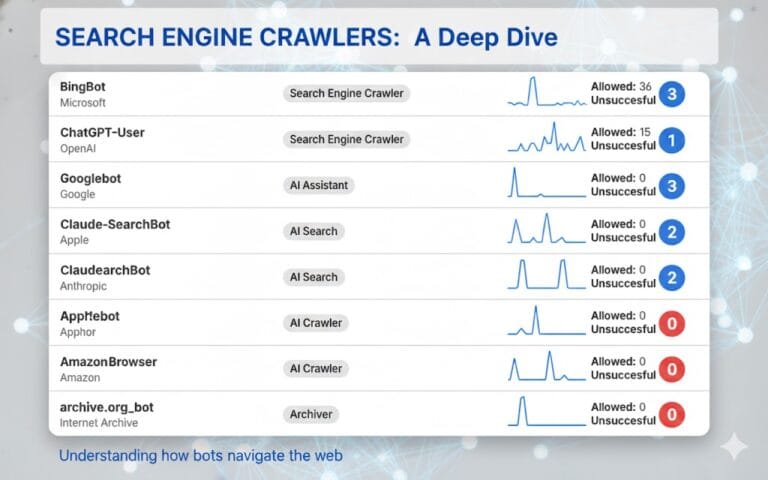
When you open your access logs or analytics, you’ll see a surprising number of “bots” hitting your pages. These visitors are not humans but web crawlers and AI crawlers. Some of them index your content for classic search engines; others collect data for AI assistants, large language models (LLMs), and new AI search products.
In this article I’ll walk through the main crawlers that often appear in modern logs, explain who built them, which country they come from, and why they access your site. This overview is focused on the most common bots you’re likely to see, not an exhaustive catalog of every crawler on the internet.
Applebot – Apple (United States)
Applebot is Apple’s official web crawler. It indexes pages for Spotlight search, Siri suggestions and Safari’s “Top Hit” results on iPhone, iPad and macOS. The bot follows links, reads HTML, titles and metadata, and builds a search index used inside the Apple ecosystem. For most websites Applebot generates modest traffic, but allowing it helps your content surface for millions of Apple users. You control Applebot via standard robots.txt directives.
Apple Inc. is a US-based technology company best known for the iPhone, Mac and iOS ecosystem. In recent years Apple has been integrating more AI and on-device intelligence into its products, which depends on high-quality indexed content. Because of its strong privacy branding, Apple also offers options to limit how your content is used for AI training if you choose.
Googlebot – Google (United States)
Googlebot is the web crawler behind Google Search. It continuously crawls and recrawls trillions of URLs, following links and obeying robots.txt and meta-robots tags. Googlebot is usually the most active bot on any public site and is responsible for turning your pages into search snippets and rich results. Well-structured HTML, fast performance and clean internal linking make its job easier and improve SEO.
Google LLC is a US company and still the dominant global search engine. Beyond classic search, Google now uses its web index to power AI experiences such as Gemini and AI overviews. For nearly all publishers, Googlebot is the single most valuable crawler to keep enabled, because it drives the majority of organic search traffic.
Bingbot – Microsoft (United States)
Bingbot is Microsoft’s crawler for the Bing search engine. It behaves similarly to Googlebot, fetching pages, respecting robots rules and building an index for Bing.com, the Edge browser and Microsoft’s AI assistant Copilot. Bingbot traffic is smaller than Googlebot’s but can still be significant, especially in regions where Bing has stronger usage or on Windows-heavy corporate networks.
Microsoft is a US-based technology and cloud company. It has invested heavily in AI, including a deep partnership with OpenAI. Bing and Copilot use web data to provide both classic search results and AI-generated answers, so Bingbot is the core pipeline feeding those systems.
Amazonbot – Amazon (United States)
Amazonbot crawls the web for Amazon. It helps improve search results inside Amazon products and powers responses in Alexa and other services. The bot collects titles, descriptions, structured data and images from public pages. It also respects robots.txt, so you can limit or block it if you don’t want your content accessed.
Amazon is a US-based ecommerce and cloud giant. Besides the retail platform, it runs Amazon Web Services (AWS) and the Alexa voice assistant. Amazonbot traffic may be noticeable if your site contains product information, reviews or content that matches popular voice queries.
Anchor Browser – Anchor (United States)
Anchor Browser is not a traditional crawler but a signed cloud browser used by AI agents. It lets AI systems browse websites like a real user while cryptographically proving which service is making the request. On your logs it shows up as a specific user-agent rather than a generic “bot”, but it still behaves like automated traffic.
Anchor is a US-based company building infrastructure for “browsers for AI agents”. Their goal is to make good bots identifiable and controllable so that websites can allow, meter or block them more precisely. As AI adoption grows, signed agent browsers like this will likely become more common.
archive.org_bot – Internet Archive (United States)
archive.org_bot belongs to the Internet Archive’s Wayback Machine. It periodically snapshots your pages and stores them as historical copies. These snapshots can later be viewed even if the original page is changed, moved or removed. The bot tends to crawl less aggressively than commercial search engines and respects robots.txt if you don’t want your content archived.
The Internet Archive is a US non-profit digital library. Its mission is to preserve knowledge and culture by archiving websites, books, audio, video and software. Because the organization is independent and long-term oriented, many site owners intentionally allow its crawler as part of preserving the public record.
Bytespider – ByteDance (China)
Bytespider is a crawler operated by ByteDance, the company behind TikTok and Douyin. It indexes web pages that may be relevant for TikTok search and recommendations, and it likely supports some of ByteDance’s internal AI products. If your content is frequently shared or discussed on TikTok, you may see more Bytespider traffic.
ByteDance is a Chinese technology company specializing in content recommendation platforms. Its apps rely heavily on algorithms that need fresh, rich data, which explains why the company runs its own crawlers. For publishers targeting TikTok audiences, allowing Bytespider can indirectly improve discoverability inside that ecosystem.
CCBot – Common Crawl (United States)
CCBot is the crawler for the Common Crawl project. It builds a large, open dataset of web pages that researchers and companies use for search experiments and training language models. When you allow CCBot, your content may end up in multiple downstream datasets used by many AI systems, not just one company.
Common Crawl is a US-based non-profit organization. Its mission is to democratize access to web-scale data that would otherwise only be available to large tech companies. Many modern LLMs have included Common Crawl data as part of their training mix.
GPTBot, OAI-SearchBot and ChatGPT-User – OpenAI (United States)
GPTBot is OpenAI’s general training crawler. It fetches publicly accessible pages and uses them, along with many other sources, to improve OpenAI’s GPT-series models. GPTBot does not send search traffic back to your site; its value is mainly that your material can shape how ChatGPT and related tools answer questions. You can opt out via robots.txt.
OAI-SearchBot is OpenAI’s crawler for search and retrieval, powering SearchGPT and citation-style results inside ChatGPT. It is more selective and tends to focus on higher-quality or more authoritative sources. Allowing this bot makes it more likely that your site will appear as a cited reference in AI answers.
ChatGPT-User is the user-agent used when ChatGPT, at a user’s request, opens a specific URL to answer a live query. This traffic is episodic and tied directly to user prompts, similar to a headless browser session.
OpenAI is a US-based AI research and product company. It created ChatGPT and several widely used language models and APIs. Because of its reach, decisions about whether to allow its crawlers have a big impact on how your brand appears in AI-generated content.
ClaudeBot, Claude-SearchBot and Claude-User – Anthropic (United States)
ClaudeBot is Anthropic’s general web crawler for training the Claude family of models. It downloads large amounts of content in order to improve the base LLM. Like GPTBot, it doesn’t directly generate referral traffic but influences how Claude responds to questions.
Claude-SearchBot is used to fetch and index pages that Claude may cite in answers. It behaves more like a search crawler, focusing on sources likely to be useful and trustworthy. Allowing Claude-SearchBot increases the chance that Claude will quote your site with a link.
Claude-User is the user-agent Anthropic uses for real-time browsing on behalf of Claude users. These requests come from explicit user actions, not continuous background crawling.
Anthropic is a US-based AI company that emphasizes safety and alignment. It develops the Claude line of assistants and offers APIs similar to OpenAI’s. Its crawlers form part of a strategy to provide grounded, cited answers.
DuckAssistBot – DuckDuckGo (United States)
DuckAssistBot powers DuckDuckGo’s AI feature called DuckAssist. It fetches content from trusted sources and from sites that allow crawling to generate concise, natural-language answers. The bot behaves like a friendly search crawler and respects your robots settings.
DuckDuckGo is a US-based search engine focused on user privacy and minimal tracking. By mixing traditional search results with AI summaries, it tries to offer a Google alternative with less profiling of users. If your audience values privacy, DuckDuckGo exposure can be important.
FacebookBot, Meta-ExternalAgent and Meta-ExternalFetcher – Meta (United States)
FacebookBot is used when someone shares a link on Facebook or Instagram. It fetches the page to generate the preview: title, description, image and other Open Graph data. Without this bot, your shared links may look broken or unattractive in Meta feeds.
Meta-ExternalAgent and Meta-ExternalFetcher act as additional fetchers and refreshers. They may revisit pages to update link previews or gather extra metadata. Their traffic is usually low and tightly coupled to how often your URLs are shared.
Meta Platforms is a US-based company that owns Facebook, Instagram, WhatsApp and other services. Its crawlers ensure that external links render nicely in the social graph and, increasingly, supply data for Meta’s AI ranking and recommendation systems.
Google-CloudVertexBot – Google Cloud (United States)
Google-CloudVertexBot comes from Google Cloud’s Vertex AI platform. It appears when developers or AI agents using Vertex call out to the web through connectors or tools. From your perspective, it looks like automated Google traffic that is not part of standard search indexing.
Vertex AI is Google Cloud’s managed AI platform. Companies use it to train and deploy models and to build agents that sometimes need to read web pages. Because this traffic is very workload-specific, volume tends to be small and bursty.
PerplexityBot and Perplexity-User – Perplexity AI (United States)
PerplexityBot is the main crawler for Perplexity, an AI-first search engine. It indexes web content so that Perplexity can answer questions with cited sources. In theory that means your site can be referenced in their answers, sending some traffic and visibility back.
Perplexity-User is used when Perplexity, at a user’s request, opens a specific URL. This is similar to a headless browser session linked to a single query rather than continuous crawling.
Perplexity AI is a US-based startup building conversational search with tight source citations. It relies heavily on external web content and has been the subject of debate about how aggressively it crawls and how it handles robots rules, so some site owners choose to monitor or restrict its bots.
PetalBot – Huawei Petal Search (China)
PetalBot is the crawler behind Huawei’s Petal Search. It indexes web pages so that users of Huawei phones and browsers can search the web even where Google services are limited. PetalBot behaves like a traditional search crawler and respects robots.txt.
Huawei is a Chinese technology and telecom company. Petal Search is its alternative search engine, integrated into many Huawei devices. For websites with audiences in regions where Huawei hardware is common, allowing PetalBot can improve local visibility.
MistralAI-User – Mistral AI (France)
MistralAI-User is the user-agent for Mistral’s “Le Chat” assistant when it browses the web for a user. It is not a broad crawler; it only visits URLs requested within conversations. As a result, the traffic is limited but highly targeted.
Mistral AI is a French AI company known for high-performance open and proprietary language models. With Le Chat it offers a European alternative to US-centric AI assistants. Its browsing features rely on respectful use of external websites.
Timpibot – Timpi (New Zealand / International)
Timpibot is the crawler used by Timpi, a decentralized search project. It collects web pages through a network of community nodes and feeds them into a distributed index. Some administrators have reported heavy crawling from this bot, so it is worth monitoring its behavior on your server.
Timpi is operated out of New Zealand and advertises itself as a community-driven, decentralized search engine. Its aim is to offer a more transparent alternative to centralized search, but the distributed nature of its crawling can sometimes surprise site owners with unexpected load.
Novelum AI Crawl – Novelum (United States)
Novelum AI Crawl is a crawler associated with Novelum (also seen as Novellum.ai). It is used by AI automation tools to scan websites and support agents that need to read external content. Documentation is still limited, so it is safest to treat its traffic as generic AI crawler activity and monitor frequency.
Novelum is a US-based company focused on observability and “autofix” solutions for AI agents and workflows. Crawling is part of how its platform maps the resources that agents interact with. If your site is used by customers building agents on Novelum, you may see this user-agent in your logs.
ProRatalnc / ProRataInc and Similar Analytics Bots
The ProRatalnc user-agent appears to be tied to analytics, measurement or security research rather than a mainstream search engine. Public information is sparse, and behavior may vary. If the bot is polite and low-volume, it may be harmless monitoring; if it causes load or comes from untrusted IPs, you may decide to block or throttle it.
Companies behind such bots are often located in the United States or Europe and specialize in web monitoring, security assessment or traffic analysis. Because they are not clearly documented, many administrators treat them cautiously and make decisions based on real-world impact on their servers.
Should You Block AI and Web Crawler Traffic?
For classic search crawlers like Googlebot, Bingbot and Applebot, the answer is almost always “no”. They bring organic visitors, visibility and long-term SEO benefits, and without them your site simply disappears from search. For social crawlers like FacebookBot and the Meta fetchers, blocking them would break link previews and make your content less attractive when shared, which usually hurts engagement.
AI crawlers are more complicated. Search-oriented bots such as OAI-SearchBot, Claude-SearchBot, PerplexityBot and PetalBot can send real users to your site when they show citations and links, so allowing them may expand your presence in emerging AI search interfaces. Pure training crawlers like GPTBot, ClaudeBot, CCBot and Timpibot primarily benefit the model owners, often with little or no direct traffic in return, and they may consume bandwidth and reuse your work commercially. Some site owners are comfortable with that trade-off; others are not.
There are also trust and compliance issues. Several AI companies have been criticised for ignoring robots settings or using stealth crawlers, which makes publishers more cautious and more likely to block by default. On the other hand, if you block every AI crawler, future assistants and AI search tools may rarely mention your brand or link to your site, which could reduce your visibility as user behaviour shifts away from classic search. A balanced approach is to allow traditional search bots, allow a few AI search crawlers that provide clear attribution, and restrict high-volume training or poorly documented bots.
Whatever policy you choose, enforce it explicitly using robots.txt, meta-robots tags and, if needed, firewall or CDN rules. Review your logs regularly, watch for new user-agents, and adjust over time. The landscape of web crawlers and AI agents is changing fast, and the best strategy is one that protects your resources without cutting you off from the discovery channels that matter most to your audience.

Comments ()