Quantum Physics & Quantum Computing: A Plain-English Glossary for Curious Minds
A beginner-friendly, plain-English glossary of the most common quantum physics and quantum computing terms—no advanced math, just clear intuition and examples.
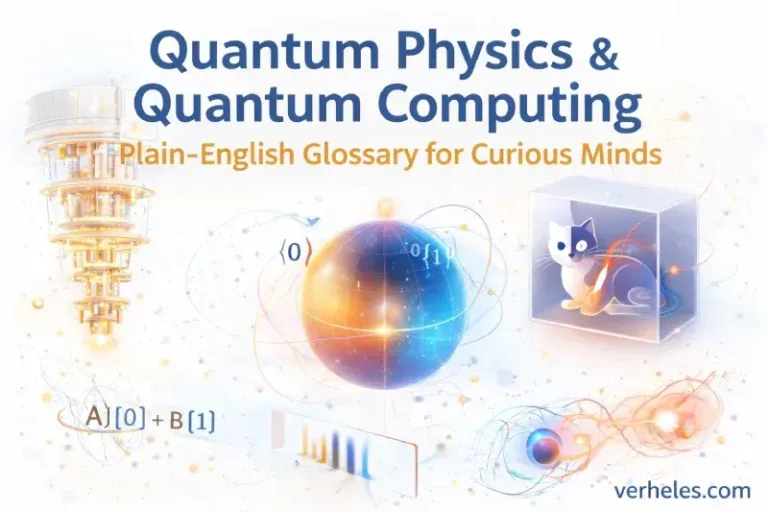
If you’ve ever watched a video about quantum computers, heard phrases like superposition or entanglement, and felt like everyone else got the joke—this guide is for you.
This post is a beginner-friendly glossary of the most common terms in quantum physics and quantum computing, written for a general audience in the United States. No advanced math, no gatekeeping—just clear explanations and practical intuition.
Why This Glossary Matters
Quantum topics show up everywhere in the US right now—tech news, university research, venture funding, and even pop culture. But most explanations either oversimplify (“it’s magic!”) or go full PhD.
This glossary is meant to sit in the middle: accurate enough to trust, simple enough to understand.
Quantum Physics Basics (The Core Ideas)
Quantum
A quantum is the smallest “packet” of something—often energy. Think of it like reality not being perfectly smooth, but coming in tiny chunks in certain situations.
Quantum State
A quantum state is the complete description of a system. It tells you what outcomes are possible and how likely they are.
Wave Function (ψ)
The wave function is a mathematical way to describe a quantum state. You don’t need to compute it to understand the idea: it’s the “information container” for what a particle might do.
Probability Amplitude
A probability amplitude is like a probability—but with a twist. These amplitudes can add and cancel each other, which is why quantum systems create interference patterns.
Superposition
Superposition means a system can be in a combination of states at once—until you measure it.
A common analogy: it’s not that the coin is “heads and tails” like a normal coin flip, but more like it’s in a blended state that becomes definite only when checked.
Measurement
A measurement is what turns quantum “possibilities” into a specific result. Measurement isn’t just “looking”—it’s any interaction that forces a definite outcome.
Collapse (Wave Function Collapse)
Collapse is a way of describing what seems to happen when you measure: the system goes from “many possible outcomes” to “one observed outcome.” Different interpretations explain collapse differently.
Observable
An observable is something you can measure—like position, energy, or spin.
Operator
An operator is the math tool linked to an observable. In plain terms: it’s the formal rule used to predict measurement outcomes.
Uncertainty Principle
The Heisenberg uncertainty principle says there are limits to how precisely you can know certain pairs of properties at the same time—like position and momentum. It’s not about bad equipment; it’s built into nature.
Interference
Interference is the pattern you get when probability amplitudes combine. It’s the same idea as waves in water—except it’s happening with quantum possibilities.
Wave–Particle Duality
Quantum objects can behave like waves or particles depending on how you test them. They are not one or the other 100% of the time.
Entanglement
Entanglement is a deep connection between particles where their outcomes are linked—even if separated. It’s not “faster-than-light messaging,” but it does create correlations that classical physics can’t explain.
Decoherence
Decoherence is what happens when a quantum system interacts with the environment and loses its “quantum behavior.”
This is why quantum systems are hard to keep stable in real devices.
Tunneling
Quantum tunneling is when a particle can pass through a barrier that classical physics says it shouldn’t be able to pass. This is real and shows up in technology (and in how stars work).
Spin
Spin is a quantum property that acts like a tiny built-in “orientation.” It’s not literally the particle spinning like a planet, but it behaves like angular momentum in experiments.
Schrödinger’s Equation
This is the main equation describing how a quantum state changes over time. You don’t need to solve it to understand its role: it’s the “motion law” of quantum states.
Bell’s Theorem / Bell Test
A Bell test is an experiment that checks whether nature can be explained by “hidden variables” the way Einstein hoped. Results strongly support quantum mechanics and entanglement.
Quantum Computing Terms (What You Hear in Tech News)
Qubit
A qubit is the basic unit of quantum computing. A normal bit is 0 or 1. A qubit can be in a superposition of 0 and 1.
Basis (Computational Basis)
A basis is the measurement “frame.” The computational basis is the usual 0/1 readout.
Bloch Sphere
The Bloch sphere is a way to visualize a single qubit. It’s a helpful picture that shows a qubit can point in many “directions,” not just 0 or 1.
Quantum Gate
A gate is an operation that changes qubits—like a step in a recipe. Gates can rotate a qubit, flip it, or create entanglement.
Quantum Circuit
A quantum circuit is a sequence of gates. It’s how quantum algorithms are represented.
Unitary Operation
A unitary operation is an ideal, reversible quantum change. Most gate operations are designed to be unitary.
Readout
Readout is the act of measuring qubits at the end of a circuit to get classical bits you can use.
Entangling Gate (CNOT, CZ)
Some gates create entanglement. Two common ones:
- CNOT (Controlled-NOT)
- CZ (Controlled-Z)
These are key for making qubits work together.
Hadamard Gate (H)
The Hadamard gate is famous because it creates superposition—turning a definite 0 into a “50/50” kind of quantum blend.
Pauli Gates (X, Y, Z)
Simple gates used constantly:
- X is like a quantum NOT
- Z changes phase
- Y mixes both effects
Phase Gates (S, T)
Phase gates adjust the “timing” (phase) of probability amplitudes. They matter because phase is what creates interference—which is what gives quantum algorithms their power.
Noise
Noise is anything that messes up the quantum state—tiny environmental effects, imperfect control pulses, temperature, or electronics.
Fidelity
Fidelity means “how close to perfect” a state or operation is. Higher fidelity = fewer errors.
Coherence Time (T1, T2)
These are two common ways to describe how long a qubit stays usable.
- T1: energy relaxation (it “falls” back to normal)
- T2: loss of phase information (it “forgets” its quantum alignment)
Quantum Error Correction (QEC)
QEC is how you protect information by spreading it across many qubits. It’s like redundancy in data storage—except much harder because measurement destroys quantum states.
Physical Qubit vs Logical Qubit
- Physical qubit: a real qubit on hardware
- Logical qubit: a more reliable qubit created using error correction across many physical qubits
NISQ
NISQ stands for Noisy Intermediate-Scale Quantum. That’s basically where we are now: quantum devices exist, but they’re still noisy and limited.
Quantum Advantage / Quantum Supremacy
These terms describe a quantum computer doing a task that would be extremely hard or impractical for classical computers. It doesn’t mean quantum computers are faster at everything.
Real-World “Quantum Experiments” People Search For
If you want to explore quantum ideas through experiments (even as a beginner), these topics are great starting points:
- Double-slit experiment (interference and measurement)
- Quantum eraser experiment (what “which-path info” does)
- Delayed-choice experiment (timing and measurement)
- Bell test experiments (entanglement in the real world)
(In a future post, I’ll break down these experiments with diagrams and simple step-by-step intuition.)
Common Myths (Quick Reality Check)
- “Entanglement lets you communicate faster than light.”
No. You can’t use entanglement to send information instantly. - “Quantum computers will replace normal computers soon.”
Not likely. Quantum computers are specialized tools, not general replacements. - “Quantum physics is just philosophy.”
Quantum physics is tested constantly and powers real technology.
FAQ (Beginner Friendly)
Is quantum physics “real,” or just theory?
It’s real—and experimentally confirmed. Many modern technologies depend on it.
Can I learn quantum physics without advanced math?
Yes. You can build strong intuition first. Math helps later, but it’s not required on day one.
What should I learn first?
Start with: superposition, interference, measurement, entanglement, and decoherence. Those concepts unlock most explanations.
Comments ()