Hanwha RTSP Stream URL (Wisenet): Correct Formats, Examples, and Troubleshooting (2026)
Find the correct Hanwha Wisenet RTSP URLs for cameras, multi-sensor models, NVRs, and DVRs—plus profile selection, ports, and troubleshooting steps.
RTSP (Real-Time Streaming Protocol) lets you pull a live video stream from Hanwha Vision / Wisenet cameras, NVRs, DVRs, or encoders into third-party software like VLC, ffmpeg, some VMS platforms, and integrations where ONVIF/API is not available.
Hanwha explicitly recommends RTSP mainly when API/ONVIF isn’t an option, because RTSP gives you video (and sometimes audio) but does not provide full device integration (events, analytics, settings control, etc.).
Quick answer: the most common Hanwha RTSP URL (IP cameras)
Templates (most Hanwha Wisenet IP cameras):
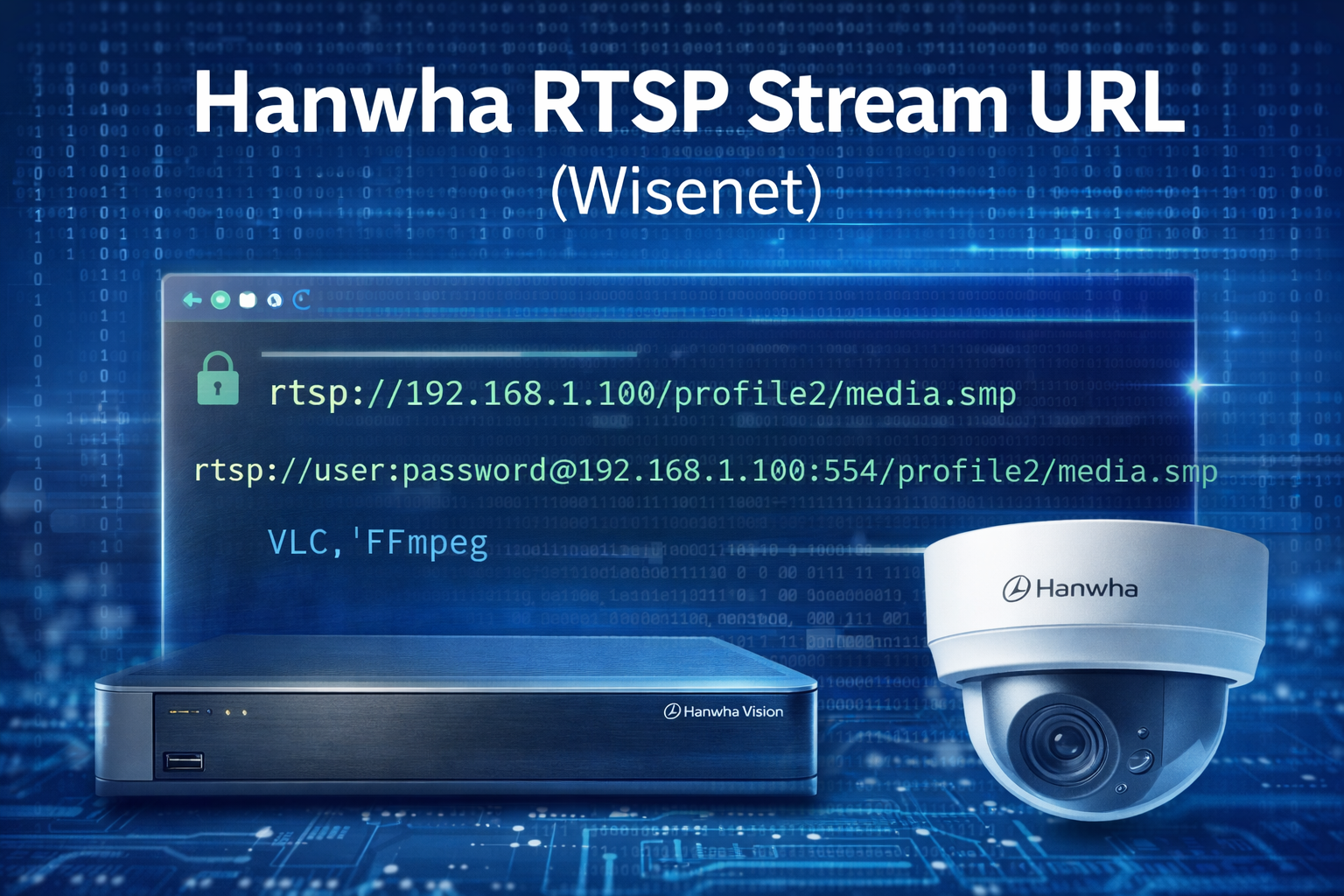
rtsp://<CAMERA_IP>/profile<NO>/media.smp
rtsp://<CAMERA_IP>:<RTSP_PORT>/profile<NO>/media.smp
rtsp://<USER>:<PASSWORD>@<CAMERA_IP>:<RTSP_PORT>/profile<NO>/media.smp
Example
rtsp://192.168.1.100/profile2/media.smp
Hanwha’s support docs use this exact example format.
RTSP port
- Default RTSP port is 554 (can be changed).
- Some ports are not available on certain devices (Hanwha notes 3702 and 49152 as not available for RTSP in their guidance).
Which “profile” should I use? (profile1 vs profile2)
Hanwha uses profile numbers to represent different streams (quality/bitrate/codec). In many installs:
profile1= main / higher qualityprofile2= sub / lower bandwidth
…but the real mapping depends on how the camera is configured. If you’re not sure, try profile1 and profile2 first, then confirm in the camera’s video profile settings (or by testing in VLC/ffmpeg). Hanwha’s own examples commonly reference profile2.
Multicast RTSP (when you need it)
Hanwha also documents a multicast RTSP format for cameras:
rtsp://<CAMERA_IP>:<RTSP_PORT>/multicast/profile<NO>/media.smp
Use multicast only when your network is designed for it (IGMP snooping/querier, etc.), otherwise it often causes “works sometimes / black screen” problems.
Multi-sensor Hanwha cameras & encoders (PNM series, etc.)
Multi-sensor devices require a sensor index, and Hanwha states the sensor numbering starts at 0.
rtsp://<IP>:<RTSP_PORT>/<SENSOR#>/profile2/media.smp
rtsp://<USER>:<PASSWORD>@<IP>:<RTSP_PORT>/<SENSOR#>/profile2/media.smp
Sensor range example: 0–3 (0 = Sensor 1, 1 = Sensor 2, etc.).
Examples (4 heads):
rtsp://192.168.1.120:554/0/profile2/media.smp
rtsp://192.168.1.120:554/1/profile2/media.smp
rtsp://192.168.1.120:554/2/profile2/media.smp
rtsp://192.168.1.120:554/3/profile2/media.smp
This aligns with documented examples for multi-sensor models.
Hanwha NVR RTSP URL (LiveChannel)
For Hanwha NVRs, the common format is:
rtsp://<NVR_IP>:<PORT>/LiveChannel/<CHANNEL>/media.smp
Important details
- Channel numbering starts at 0 (Channel 1 in the UI often equals
0in RTSP). - Hanwha notes the RTSP port for NVRs is often the last Device Port in the configured range (example: if 554–558, then 558 is RTSP).
Picking a specific NVR profile (advanced)
Hanwha provides a way to find and request a specific NVR streaming profile:
- View the profiles via CGI:
/stw-cgi/media.cgi?msubmenu=videoprofilepolicy&action=view - RTSP stream with a chosen profile number:rtsp://<NVR_IP>:<LAST_DEVICE_PORT>/LiveChannel/<CHANNEL>/media.smp/profile=<NUM>
This is extremely useful when the “main vs sub” mapping isn’t obvious.
Hanwha DVR RTSP URL (SRD / HRD / HRX)
Hanwha documents different formats for SRD vs HRD/HRX. Key rules:
- Channel numbering starts at 0
- Device port is typically the last port in the configured range (default often shown as 558 in examples).
SRD series
rtsp://<SRD_IP>:<LAST_DEVICE_PORT>/<CHANNEL>
Example:rtsp://192.168.2.220:558/0
HRD & HRX series (SUNAPI-style like NVR)
rtsp://<HRD_IP>:<LAST_DEVICE_PORT>/LiveChannel/<CHANNEL>/media.smp/profile=<NO>
Example: rtsp://192.168.2.220:558/LiveChannel/0/media.smp/profile=1
How to test Hanwha RTSP quickly
VLC (fastest)
- Media → Open Network Stream
- Paste RTSP URL
- If it fails, try:
- switching RTSP to TCP
- increasing network caching (e.g., 500–1000 ms)
Hanwha explicitly mentions VLC as a valid way to test RTSP streaming.
ffmpeg / ffplay (best for troubleshooting)
ffplay -rtsp_transport tcp "rtsp://USER:[email protected]:554/profile2/media.smp"
Common problems (and what a technician checks first)
1) “No video / black screen”
Most often:
- wrong
profile<NO>(try profile1 then profile2) - wrong credentials
- RTSP disabled / permission not granted to the user
2) “Connection timed out”
- RTSP port blocked (firewall/VLAN rules)
- wrong port (remember: NVR/DVR may use the last device port in range).
3) “Works in one app but not another”
- Codec mismatch (H.265 support varies by app/device)
- UDP vs TCP transport differences (TCP is often more stable across routed networks)
4) Multi-sensor streams not working
- wrong sensor index (
/0/,/1/,/2/,/3/) — Hanwha starts counting from 0.
Security best practices (do this even at home)
- Create a dedicated read-only user for RTSP (don’t reuse admin).
- Keep cameras/NVR on a separate VLAN and allow RTSP only from trusted hosts.
- Avoid embedding credentials into links you share; prefer app credential storage.


Comments ()