Brivo and Eagle Eye Networks Merge: What It Means for Chicago Security Systems
If you manage a building in Chicago (or the North Shore suburbs) and you’ve been moving toward cloud access control and cloud video surveillance, you’ve probably heard the news: Brivo and Eagle Eye Networks are merging to form what they describe as the largest AI cloud-na...
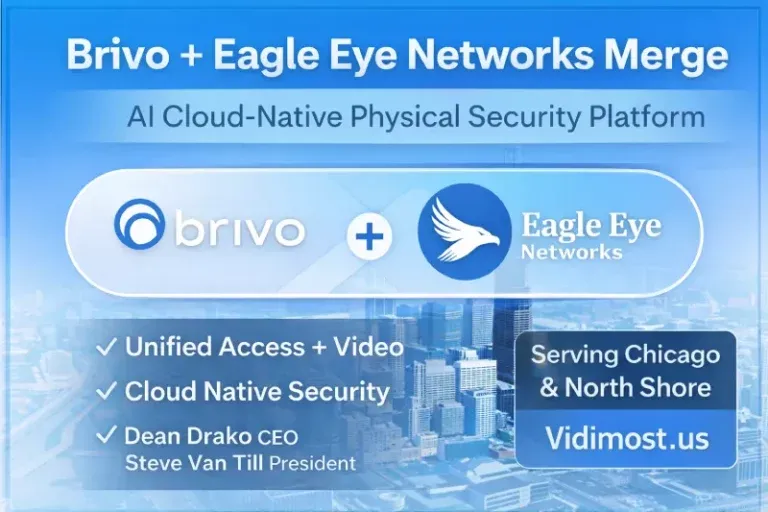
If you manage a building in Chicago (or the North Shore suburbs) and you’ve been moving toward cloud access control and cloud video surveillance, you’ve probably heard the news: Brivo and Eagle Eye Networks are merging to form what they describe as the largest AI cloud-native physical security company.
This is a big deal—especially for property managers, HOAs, mixed-use buildings, and businesses that want one ecosystem instead of stitching together separate video and access tools.
I’m a Chicago-area security integrator at Vidimost LLC, and I work hands-on with both platforms. I’m also certified with Brivo and Eagle Eye, so I’ll break down what the merger means in practical terms for your sites and projects. (More at vidimost.us.)
Why this matters for Chicago businesses and multifamily buildings
1) A stronger “single pane of glass” story
Brivo highlights its vision of a consolidated suite that brings access control, video intelligence, visitor management, and intrusion into one environment.
For Chicago property managers, this can translate in
- Fewer logins and fewer dashboards
- More consistent permissions/user management
- Cleaner workflows for security staff and front desks
2) Faster deployments for multi-site portfolios
Chicago operators commonly juggle:
- A downtown HQ + warehouses
- Multiple suburban offices
- Multifamily properties across neighborhoods
A cloud-first approach is already ideal for multi-site. With the merger, the combined roadmap is clearly pushing toward even tighter access + video alignment.
3) Better alignment between video evidence and door events
When systems are integrated well, you can reduce “guesswork”:
- Door forced open → instantly pull the matching camera clip
- Propped door alerts → verify visually without sending staff right away
- Visitor access + delivery workflows → easier audits
What (likely) won’t change overnight
Even with a merger, most customers shouldn’t expect a sudden “rip and replace.” The announcement emphasizes a unified direction and support experience, but real-world platform consolidation typically happens in phases.
What you can do now is plan smart:
- Standardize credentials (cards/mobile)
- Improve network readiness (VLANs, PoE budgets, uplinks)
- Clean up door schedules, roles, and event definitions
- Align camera coverage with critical doors (especially vestibules and loading areas)
A quick refresher: what each platform is known for
Brivo is known for cloud-native access control and “smart space” security, and the press release describes its broader suite approach.
Eagle Eye Networks is known for cloud video surveillance (Cloud VMS) and emphasizes cloud scalability, subscription pricing, analytics/AI, and an open API approach.
In practice, that pairing is attractive because access control + video is what most Chicago properties want as a unified standard.
What Chicago clients should ask their integrator right now
If you’re planning a project in 2026 (or refreshing an older system), here are the questions that avoid expensive mistakes:
- Are we designing for cloud from day one?
Meaning: reliable internet paths, proper firewall rules, realistic uplink bandwidth, and a plan for outages. - Do we want mobile credentials and visitor flows?
Multifamily and office tenants increasingly expect phone-based access and smoother guest handling. - What’s our camera retention and cyber posture?
You need clear retention targets, user access policy, and secure remote access practices. - How will we scale across multiple buildings?
Centralized administration matters in Chicago portfolios—especially when you have different managers per site.
How Vidimost.us can help (Chicago & North Shore)
At Vidimost LLC (vidimost.us), I help Chicago-area clients design and deploy Brivo + Eagle Eye solutions that are:
- Cleanly integrated (door events ↔ video verification)
- Network-ready (VLANs, PoE, UPS, remote management)
- Built for growth (more doors, more cameras, more sites)
And because I’m certified on both Brivo and Eagle Eye, you’re not getting generic advice—you’re getting implementation detail that avoids headaches later.
FAQ: Brivo + Eagle Eye merger
Is Brivo buying Eagle Eye Networks?
The announcement states the companies will merge and operate under the Brivo name.
Will Brivo stop integrating with other video or access platforms?
They explicitly say they’ll maintain an open platform approach and continue supporting other solutions.
Who will run the combined company?
The release states Dean Drako will be CEO of Brivo and Steve Van Till will be President.
Does this change my existing system today?
Usually, existing deployments remain stable while product teams align roadmaps. The practical move is to plan upgrades and new projects with the “unified platform” direction in mind.
Bottom line for Chicago
This merger is a strong signal that the market is moving toward cloud-native, AI-assisted, unified physical security—where access control and video are designed to work together, not merely “integrate.”
If you’re in Chicago or the North Shore and want to evaluate what this means for your building (or plan a modernization project), check out vidimost.us—I’m happy to help you map the right path with Brivo and Eagle Eye.
Comments ()